The Silent Struggle of Motherhood: Understanding Postpartum Decline in Maternal Health
- Charithma Peiris

- Apr 6
- 4 min read
Although some believe that poor maternal mental health is a temporary side effect immediately after childbirth, symptoms can extend beyond this period. A study examining self-reported surveys established that maternal mental health has been declining every year, with a notable decrease from 38.4% to 25.8% occurring between 2016 and 2023 in the United States. This meant that more mothers reported good and poor/fair mental health compared to excellent mental health each year after 2016 (Daw 2025).
These declines were observed more frequently due to factors such as age, education, insurance, single parenting, and multiracial children (Daw 2025). In a time where expecting mothers have to grapple with stressors such as limited access to healthcare, racism, gun violence, climate change, inflation, and social isolation, it is important that we acknowledge this mental health crisis. A contributing factor to the maternal mental health crisis is the lack of affordable education.
In a society that emphasizes the importance of a career and education, it is not accessible to a wide variety of the population because of inflated prices. College tuition leaves thousands of middle class families in debt, who make up a majority of Americans. Higher education is associated with better maternal mental health, but the economical barrier prevents many from following their educational dreams (Kotimäki 2020). This later becomes a factor for their poor maternal health due to many reasons including backlash from society due to lower levels of education.
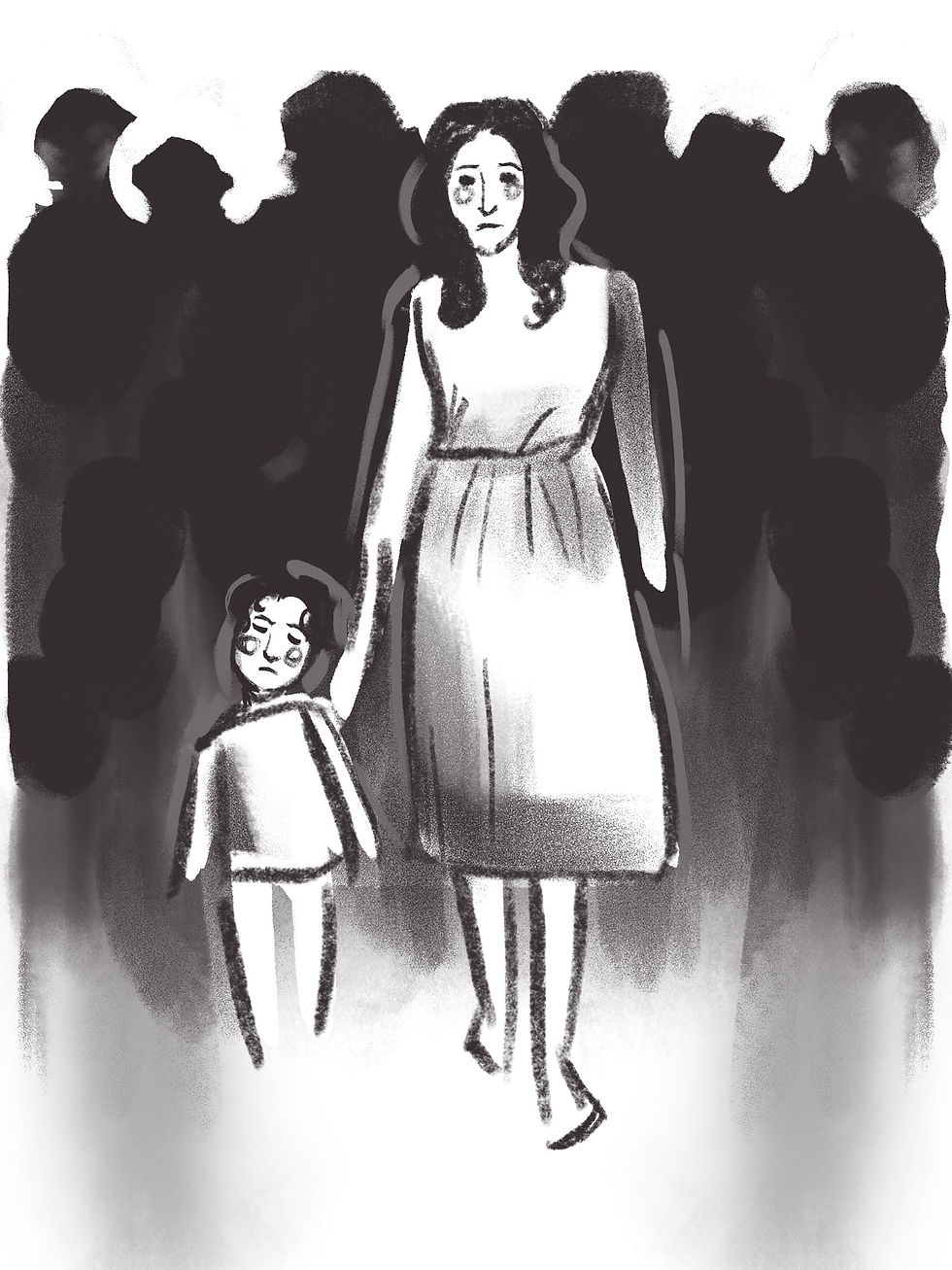
This societal pressure is a factor that has not been as much of a focus in current research because it is more difficult to make conclusions about something without traditional statistical evidence. However, it is crucial to understand complex social experiences such as internalized stress and social pressure so that we can narrow the gap in research. We can help mothers grapple with mental health struggles by understanding these gaps, and more effective interventions would be possible after.
Technological advances have also played a role in more of an isolated society, which is a direct contributor to a decline in maternal mental health. Generation Z, especially, is assumed to have declining mental health because of the different social environment they grew up with because there was an increase in exposure to social media during childhood and adolescence for them (Daw 2025). Developmentalists speak of urbanization’s effect on developing children in closed spaced environments that limit their growth in many ways. Surely, this affects society as a whole as community support seems to have declined as well. Isolation due to technology and urbanization have led to mothers having to tackle pregnancy, childbirth, and raising children without much community support.
What would help improve these factors?
Making higher education more accessible would involve increasing financial aid, tuition control, and making reforms to the student loan system. Similarly, inclusive social and healthcare support systems are needed to address this increasing crisis as 22.7% of deaths in the United States are pregnancy-related deaths, stemming back to incidences of declining maternal mental health (Daw 2025).
Awareness in this crisis is crucial for the mothers that also receive criticism for following their passions through higher education, not receiving higher education, having a job, not having a job, or anything they choose to do. This distress adds on to what motherhood brings them, leading to poor mental health. It is important that we choose to be kinder and more compassionate to each other as a society.
Mothers struggling with poor mental health have significantly improved through counselling interventions.
A literature review of several studies conclude that therapies such as Cognitive Behavioral Therapy (CBT) and Interpersonal Therapy (IP) especially reduce perinatal depression by 39% within six months after birth (O’Connor 2019).
Perinatal depression is during pregnancy or up until about a year after pregnancy. Other approaches to tackling this issue were peer counselling and support groups, which tie back to the importance of a supportive community for expecting and postpartum mothers (O’Connor 2019). Although this study specifies findings for perinatal depression, these therapy approaches help support all mothers beyond pregnancy and postpartum.
Looking back to generations that came before, mothers also received a great deal of support from their community and even extended family, and though new advances have changed circumstances for mothers, appropriate support systems have not followed. Through technology, COVID-19 and other factors, we have become attuned to a more closed off lifestyle. Without acknowledging these issues such as the loss of community support, social and educational disparities, the efforts to improve maternal mental health will be incomplete. While research progresses towards understanding complexities in this matter, we can support mothers in our communities by offering time, resources, or even simply fostering stronger connections with them.
Citations
Daw, J. R., MacCallum-Bridges, C. L., & Admon, L. K. (2025). Trends and disparities in
maternal self-reported mental and physical health. JAMA Internal Medicine, 185(7),
Kotimäki, Sanni et al. “Educational differences in prenatal anxiety and depressive symptoms
and the role of childhood circumstances.” SSM - population health vol. 12 100690. 10
Nov. 2020, doi:10.1016/j.ssmph.2020.100690
O’Connor E, Senger CA, Henninger M, et al. (2019). Interventions to Prevent Perinatal
Depression: A Systematic Evidence Review for the U.S. Preventive Services Task Force.
Agency for Healthcare Research and Quality (US) (Evidence Synthesis, No. 172.)
Chapter 3, Results. https://www.ncbi.nlm.nih.gov/books/NBK537815/


Comments